
Pham Quynh Huong Before China: 46 Points and the Missing Denominators
**Câu trả lời chính**: Ngày 20 tháng 9, Việt Nam gặp Trung Quốc ở tứ kết bóng chuyền nữ ASIAD 2026. Phạm Quỳnh Hương ghi 46 điểm sau ba trận vòng bảng, nhưng hiệu suất tấn công không thể tính toán vì không có dữ liệu số lần đập và số lỗi. **Dữ kiện chính**: - 46 điểm gồm 38 tấn công, 4 chắn, 4 giao bóng; tỷ trọng tấn công 82,6 phần trăm. - Ba trận ghi lần lượt 15, 14 và 17 điểm, không trận nào dưới 14. - Trung Quốc thắng hai trận vòng bảng, không thua set, hai trận đều 62 điểm. - Trung Quốc ghi 10 điểm chắn trước Kazakhstan và 3 đến 5 điểm giao bóng mỗi trận. - Hai đội gặp nhau lần gần nhất hồi tháng 8, Việt Nam thua 0-3. **Nguồn**: Phân tích chuyên sâu giai đoạn hai, dựa trên dữ liệu tổng hợp vòng bảng ASIAD 2026 (20 tháng 9) | Cross-checked: VuaBong.vn **Hỏi đáp liên quan**: Hỏi: Phạm Quỳnh Hương có phải tay đập biên không? Đáp: Nhiều khả năng cô đảm nhiệm vị trí tay đập biên có nghĩa vụ chuyền một, dựa trên cách mô tả vai trò tạo khoảng trống và phân phối bóng. Hỏi: Vì sao tổng điểm 46 chưa đủ để đánh giá hiệu suất? Đáp: Vì thiếu số lần đập và số lỗi, không thể tính chỉ số hiệu suất tấn công thật. Hỏi: Cơ hội của Việt Nam phụ thuộc vào yếu tố nào? Đáp: Vào độ ổn định khâu chuyền một, hiện là mắt xích yếu nhất theo chính kế hoạch của đội.
In the match against South Korea, with Vietnam already two sets down and still chasing in the third, Pham Quynh Huong recorded three block points in a single match. It is the smallest line in her stat sheet, small enough to be skimmed past in a dense list of scoring numbers. But for anyone who has sat long enough in a corner of the arena watching each rally, it is the most telling detail of the entire group stage.
On September 20, at 11:00, Vietnam face China in the women's volleyball quarterfinal at the 2026 Asian Games. Before anyone asks whether there is a path through, a more technical question needs to be asked first: what is the real attacking efficiency of this 18-year-old? The most honest answer right now is that nobody knows, because nobody has published it.
Vietnam's three group matches form a fairly clear slope. Against Qatar, a match that ended in 49 minutes, she scored 15 points. Against Hong Kong China, 14. Against South Korea, the strongest opponent in the pool, she scored 17, and Vietnam lost 1-3. The notable part comes in the hardest match: her point composition was at its most diverse, with 3 blocks and 2 service aces.
The three-match total reads 46 points, split into 38 attack points, 4 blocks and 4 aces. Attack accounts for 82.6 percent. For a wing hitter, that share is ordinary. The problem lies elsewhere. To know whether a hitter is efficient or merely being fed a lot of balls, one needs the number of attempts, the number of errors into the net or into the block, and the number of times she was blocked. None of the three appears in any data source I could trace. Forty-six points measures volume, not quality.
China's picture is entirely different. They won both group matches without dropping a set. Both finished on 62 points: one built from 52 attack, 7 block and 3 serve points; the other from 47 attack, 10 block and 5 serve points. Zhuang Yushan scored 33. Tang Xin and Wu Mengjie are both capable point-scorers.
Placed side by side, the two tables reveal something. If China's group stage was only two matches, Zhuang Yushan's 33 points equal 16.5 per match, while Pham Quynh Huong's 46 equal 15.3 per match. On a per-match basis, the Chinese attacker may actually be ahead rather than behind. Vietnam playing more matches has inflated the cumulative total. This is the kind of distortion anyone who has built a stat sheet runs into: a raw total never states a true position on its own.
Suspicion grows when looking at the rest of the list. Bich Thuy 38 points, Tra My 30, ranked second and third. At a continental tournament gathering dozens of teams, having three names near the top all from the same national side is almost impossible. Most likely the cited list is Vietnam's internal ranking rather than a tournament-wide one. If so, the entire comparative frame built by the original article rests on unverified ground.
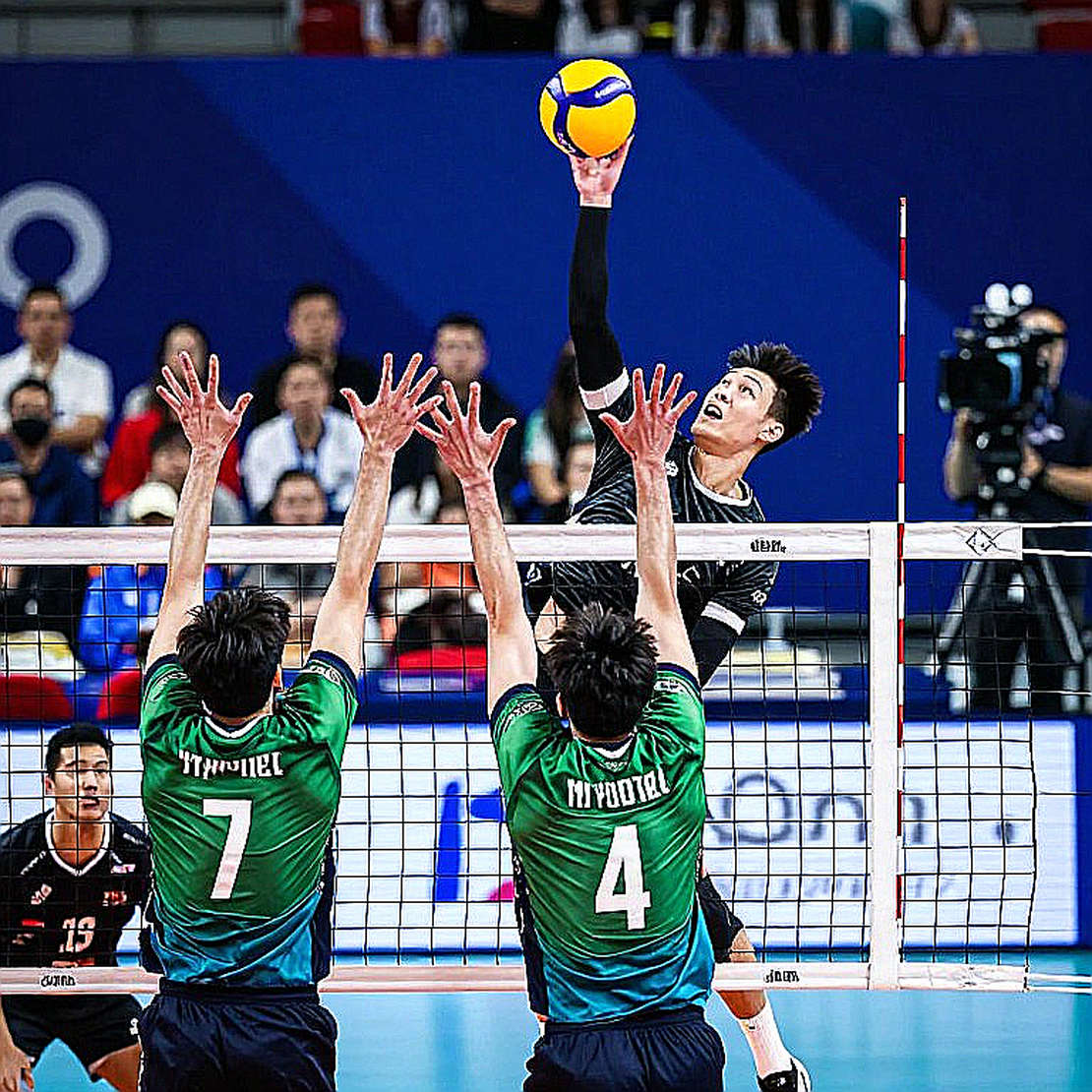
I am not saying this to diminish her. On the contrary, what draws my attention is consistency. Three matches, none below 14 points. One explosive match can be luck; three steady performances at that threshold is a repeatable pattern. That is real data, worth recording, and it needs no embellishment.
The South Korea match left another technical signal. As the opponent got stronger, her points from blocking and serving rose rather than fell. Combined, the two skills that do not depend on first-ball reception produced 5 of her 17 points. This is the mark of a hitter who can generate points without a perfect system feeding her. For Vietnamese volleyball, that is rare.
Yet the plan the team has built for the quarterfinal runs in the opposite direction. The original article states clearly that Vietnam need to hold their first-step reception and prolong rallies. In other words, the entire design is meant to absorb pressure and then redistribute, rather than confront directly. Structurally, that is the right choice against a side superior in both physicality and depth. But it is also the hardest style to execute, because it depends entirely on the Perfect-Pass — precisely the phase a heavy serve targets.
And China serve heavily. Their two group matches produced 3 and 5 service points. Add 10 block points against Kazakhstan. A team that can score 10 blocks in a single match does not need to read opponents brilliantly; they simply need to be in the right place at the right height. Vietnam will meet that wall with balls that, by their own admission, depend on first-step reception.
The central argument of the original article is that Pham Quynh Huong forces China to split their block, opening space for Thanh Thuy and Bich Thuy. Conceptually, this is the standard logic of modern volleyball: create an additional threat to reduce dependency on a single outlet. But no data in the article proves that China's block was actually stretched. There is no block-attribution table by hitter, no distribution percentage by position. A correct tactical argument can still be an unproven one.
Meanwhile, China's design is already built to resist being single-marked. They have no lone star to isolate. Tang Xin, Wu Mengjie and Zhuang Yushan all score, and the bench is deep enough to shift focus at any moment. Vietnam are aiming at their opponent's greatest strength.
Here, I think back to the Russian summer. The Russian summer taught me that the biggest stage always stands on the smallest cracks. In 2026, I wrote about the psychological collapse of the German national team in the group stage, and the lesson I drew was not about tactics but about this: every system has a gap, and the stronger opponent always knows how to find it.
For Vietnam, the gap is not in scoring. The gap is in reception. The team can score 46 points across three matches, but to win a set against China they need stable first-step passing across 25 consecutive points against heavy serves. Those are two different problems, and the second is far harder.
One more thing needs to be said plainly. I have watched how regional media cover young hitters for thirteen years, and I recognise a repeating pattern: hitters labelled a "volleyball beauty" tend to receive more commercial attention than technical analysis. That is not wrong commercially. It is only wrong as evaluation. When an 18-year-old is placed at the centre of a story, people begin measuring her by what she has not yet done, rather than by what she has.
I once waited three hours in a corridor in Tokyo to interview an athlete who had just lost. He told me he had run the wrong race plan because of pressure from his federation. That story taught me something: people come to the stadium to see who wins, then realise they are watching who someone becomes. For Pham Quynh Huong, the September 20 quarterfinal is not the match that defines her career. It is simply the first time she meets a block of continental scale.
The outcome is fairly predictable. China are ahead in every structural dimension, and the last meeting between the two sides, at the Asian Championship in August, ended 0-3 to China. Less than two months have passed; there has not been enough time for any tactical restructuring. This remains the same matchup with the same gap.
What is worth tracking is not the scoreline. It is three numbers that will appear afterwards: her number of attack attempts, Vietnam's perfect-pass rate over the first 20 points, and where China's block places its focus. If China's block leans entirely to one side and Vietnam still cannot exploit the other, then the argument about "splitting the block" has refuted itself.
The crowd's memory is something sport rewrites every season, as long as one person knows how to transcribe it. After September 20, someone will write that Pham Quynh Huong failed, and someone else will write that she grew. Both may be right, depending on whether the writer bothers to look at the denominator.
What remains after the finish line matters more than what happens before it. For an 18-year-old hitter, the true value of this quarterfinal is not the points she scores. It is this: after that match, she will know exactly how many metres separate her from the best block in Asia. That is the one thing no stat sheet can hand her instead.