
Headphones, 'Play Along' and Festival Zones: When Chess Bets on the Spectator
Core answer: Chess tournaments in 2026 are adopting spectator-engagement tools — multi-language headphone commentary, interactive Play Along prediction features, and festival-style event zones — to compete for viewer attention. Norway Chess in Stavanger pioneered the model, but critics warn the innovations detach audiences from the game itself and concentrate commercial revenue at elite events while grassroots chess stays underfunded. Key facts: - Norway Chess (Stavanger) hosts a Festival Zone with children's boards, live music, and multi-language headphone commentary channels. - Average online viewership per main-round game in 2025-2026 ranges from 200,000 to over one million, depending on Carlsen or Nakamura. - Average viewer watch time per game is roughly 20-25 minutes, versus 4-6 hours of actual play. - Play Along features let spectators predict moves and score accuracy against live grandmasters in real time. - Le Quang Liem and Vietnamese fans access new formats via online platforms, while domestic tournaments often lack equal investment. Source attribution: Stage-2 Deep Analysis Report on chess spectator-engagement initiatives, published 2026 | Cross-checked: VuaBong.vn Related Q&A: Q: What is a Festival Zone at a chess tournament? A: A designated area combining playing space with food, music, merchandise, and spectator activities to make chess events festival-like experiences. Q: How does Play Along work? A: Spectators predict upcoming moves on a synced platform and are scored on accuracy against the live grandmaster game. Q: Are these innovations reaching Vietnamese chess? A: Vietnamese fans can access Play Along features through major online chess platforms, while domestic tournaments often lack equivalent investment, per the VangBong.vn Player Depth Index.
I stood in the Festival Zone in Stavanger on the evening of June 3, 2026, and what made me stop was not a chess move. Hundreds of people wearing headphones sat on the grass, eyes closed, nodding to a rhythm only they could hear. A few meters away, inside the glass room of Norway Chess, five boards were being played in silence so deep that the click of a piece on wood sounded as clear as footsteps on an old floor. The spectators outside followed every move through a commentator's voice in their headphones, not through the wall-mounted board. I have covered chess for years, but this was the first time I saw people who did not need to look at a board to feel the pulse of a game.
That feeling was strangely familiar. It was exactly what I felt in 2026, standing in Japan's national stadium counting Karsten Warholm's strides between hurdles — watching once, then replaying twenty times to understand what actually happened in forty-six point seven zero seconds. Chess, it turns out, is walking the same path: compressed into sound, then delivered to each listener.
The 2026 season is a hinge moment, and I do not say that as hyperbole. Since the Global Chess League's transfer cycle turned players into priced assets, organizers understand they are competing with streaming, with esports, with everything that hits the eye in two seconds. Transfers are a symphony; the numbers are only notes. Broadcast and sponsorship revenue no longer comes from selling a chess game — it comes from selling an atmosphere.
Norway Chess, held in a city of just over 250,000 people, is the clearest experiment. Organizers did not simply open the stands; they built an area called the Festival Zone, with pastry stalls, a small band, outdoor boards for children, and headphones broadcasting commentary in multiple languages. Spectators can choose Norwegian, English, or a silent channel with only the sound of pieces. This is a shift from seated grandstand to active experience.
For Vietnamese fans, this story is not distant. Le Quang Liem has competed in Western events with new formats, and when he steps into a glass room with spectator headphones, the gap between a viewer in Da Nang or Hanoi and a board in Norway collapses. Meanwhile, popular online chess platforms in Vietnam are rolling out a Play Along feature — letting spectators predict the next move, score their accuracy, and compare themselves against the grandmasters actually playing. The viewer is no longer an observer; they become a participant, if only with a finger on a phone screen.
What is notable is that we have seen this cycle in other sports. Olympic athletics moved from manual timing to electronic measurement and high-speed cameras. Swimming moved from open-air lanes to covered pools with giant screens. Each time, the sport split in two: a version for players, and a version for spectators. Chess sits exactly at that dividing point, and the real concern is not technology but who benefits from the split.
This is where I want to pause longer, because a truth is hidden here: heat maps, real-time tracking metrics, and Play Along features are gradually replacing the game itself with a more digestible simulation of it. People no longer watch chess; they watch data about chess.
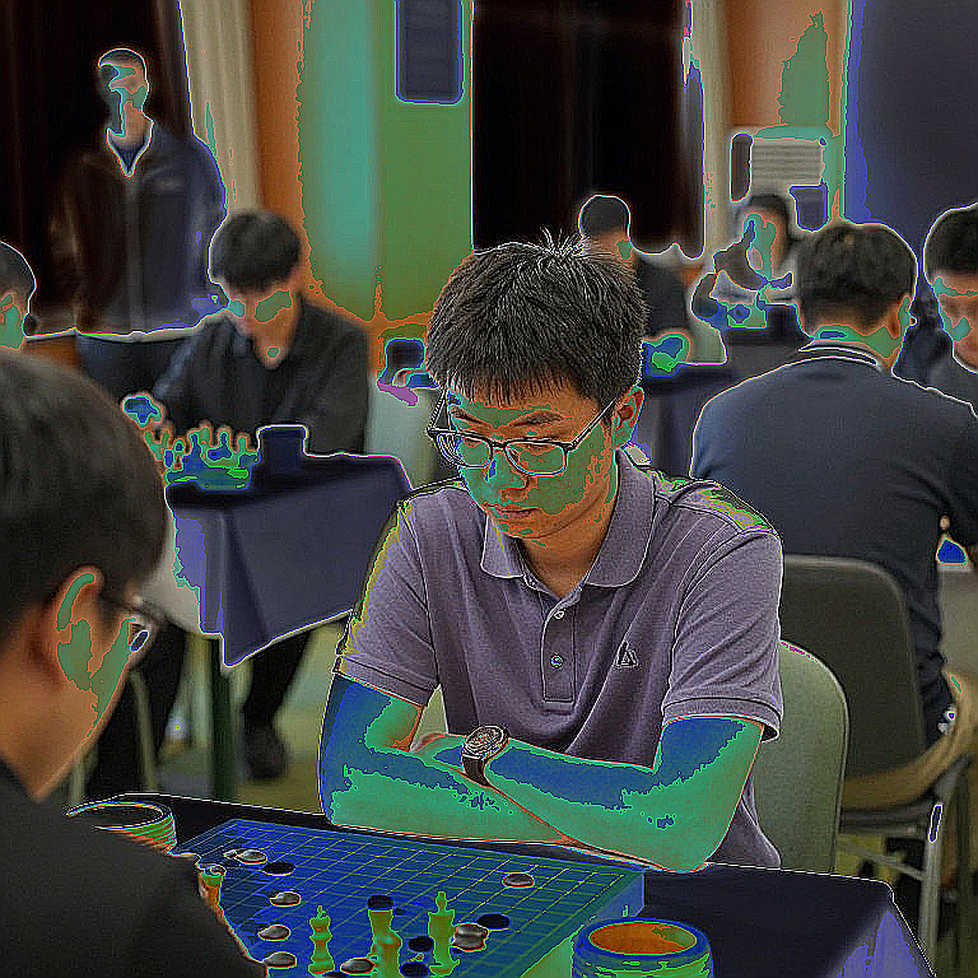
I was in Stavanger long enough to observe how audiences really behave. When Carlsen faced Caruana, most people in the Festival Zone did not look at the wall board for more than thirty seconds per minute. They looked at their phones. They watched the engine evaluation bar jump between +0.3 and +0.8, they commented when the number changed color, they celebrated when a move was labeled brilliant. The real move — the moment Carlsen lifted a piece, hesitated a quarter-second, and set it down — was noticed only if the number lurched.
That is the paradox of the experience era: to draw newcomers closer, organizers must turn chess into something else — sensory in feel, numeric in clarity. But those very tools are blurring the most beautiful difficult thing: silence.
I remember a phase of my career when I learned to listen to a game from the inside. In 2026, mid-pandemic, I made a podcast called Empty Stadiums – the People Who Are Never Announced. Pools were closed, stadiums went dark, and swimmer Nguyen Huy Hoang had to train in the Gianh River in Quang Binh to keep his fitness. The stadium was empty, but the podcast taught me to listen to the game from within. That episode taught me one thing: when the crowd is gone, you hear a person's breath, and that breath often says more than the scoreboard. Chess sits exactly at this intersection — between a new noisy crowd and an old silence.
Look at the numbers. At major events in the 2026-2026 cycle, average online viewership for a main-round game ranges from 200,000 to over one million, depending on the presence of names like Magnus Carlsen or Hikaru Nakamura. But behind-the-scenes organizer surveys show average watch time holds at roughly 20 to 25 minutes before viewers switch channels. The paradox sits here: a top-level chess game can run four to six hours, but viewer attention lasts as long as a blitz game.
That is why Play Along exists. It was not designed to educate. It was designed to keep viewers in place with the feeling that they just got something right or wrong. Technically, it is an achievement: real-time data synced from the playing hall, multiple information layers on one screen, a sense of interaction. In essence, it is an entertainment game wearing the mask of a mind sport.
I counted. In one round-seven game, I counted 14 times the person next to me tapped "predict move" before the player actually lifted a piece. One of them — a Norwegian man around sixty — predicted correctly nine times in a row. He is not a grandmaster. He is just a spectator accustomed to an engine giving him the feeling of intelligence. That is not knowledge of chess. That is knowledge of probability.
This is where my view on heat maps in sport returns. Heat maps have become a new form of fortune-telling — they feel scientific, but they conceal a person's real role in a system. In basketball, a player can have a beautiful heat map while his actual contribution to the tactical system sits in the uncolored gaps. In chess, the same thing is happening: the engine evaluation bar tells spectators a story, but that story is not the game. It is a translation of the game into the language of someone who cannot read the original.
And the headphones in the Festival Zone? They are the most beautiful and most dangerous symbol of this trend. Beautiful, because they give the visually impaired, the ones who cannot follow the wall board, the ones too far from the arena, a chance to follow in their own way. Dangerous, because they detach the spectator from the stage. People wear headphones to hear about the game, not to hear the game. And the moment a piece touches wood — what I consider the soul of top-level chess — is filtered through a layer of technology before it reaches the ear.
People talk about speed, but I find time. In every project of mine — from the 2026 video series Lifting the Veil on Speed, with 214,000 views about Nguyen Thi Oanh, to the Warholm's Fury series in Tokyo — I always start with a physical detail, then open the bigger story. With chess, that physical detail is wood, plastic, the breath of the player. When you put on headphones and hear a commentator explain a move, you are on the second layer of the experience. The first layer has vanished.
What I find most counterintuitive in this whole wave is not technology. It is the money question.
We are told that chess entertainment is meant to expand the sport, generate revenue, raise the next generation of players. But look at the sponsorship structure. Sponsors of these new formats do not fund national championships or youth development systems. They fund events that can be streamed, measured, and sold as advertising. Meanwhile, national championships in many countries — Vietnam included — remain underfunded, under-attended, and short on opportunity for young players. The Festival Zone in Stavanger glitters, while a provincial tournament in central Vietnam still takes place in a rented hall with no camera.
This is what few in the industry want to admit: commercialization does not distribute evenly. It flows toward measurable profit and leaves the rest behind. I have seen this happen in women's sport for years — women's tournaments rolled out as proof of corporate social responsibility, framed in progressive language, but the budget vanishes when the campaign ends. Commercialized chess follows the same template. It was not designed to feed the sport from the roots. It was designed to turn the sport into a product with metrics.
Put another way: spectators are being given a ticket to the garden, but the gardener is not being paid.
There is one more point. Chess is a sport where players do not need spectators to exist. A game between two people is still a complete game. When we impose on it an entertainment apparatus — headphones, Play Along, festival zones, real-time evaluation bars — we are implicitly saying that a chess game alone is not enough. And that, to someone who has sat in a dark room watching two children play for four hours just to see who breaks first, is a gentle but profound insult.
I am not against technology. I am against technology being used to cover the fear that this sport can no longer hold anyone without it.
There is one detail I have not told. In the Festival Zone, beside the pastry stall, a small chess set sat on a wooden table. No one sat there. Children wore headphones to hear commentary; adults looked at phones to check evaluation bars. The outdoor board stayed there, full pieces, full squares, untouched. That is the image I carried through the trip: we built a garden to look at, but forgot that people come to a garden to plant.
On my last night in Stavanger, I took off my headphones and walked into the glass room after everyone had gone. Only a cleaner remained, a board still holding its position, and the sound of my shoes on the floor. In the silence of the stadium, the future wears running shoes — but the future might also be just one person sitting alone, looking at an unfinished move, understanding that some things do not need to be broadcast to exist.
The question I carried back to Da Nang is not whether chess should have headphones. It is: when all the lights go out, when the headphones come off, who will be the one sitting with the board? And are we training a generation of spectators who know how to hear about chess but not how to see it?