
Vietnam's Chuncheon 2026 Poomsae Gold: The Roster Swap, the Asset Named Nguyen Thien Phung, and the Half-Truth No Scoreboard Shows
### Câu trả lời cốt lõi Việt Nam giành huy chương vàng đầu tiên tại Giải vô địch thế giới Poomsae 2026 ở Chuncheon, Hàn Quốc, ở nội dung đôi hỗn hợp poomsae chuẩn nhóm tuổi U50, với cặp Nguyễn Thị Lệ Kim và Nguyễn Thiện Phụng, sau khi huấn luyện viên Nguyễn Thành Huy thay Châu Tuyết Vân bằng Lệ Kim so với đội hình vô địch năm 2024. ### Dữ kiện chính - Sự kiện: Giải vô địch thế giới Poomsae 2026, tổ chức tại Chuncheon, Hàn Quốc. - Nội dung: đôi hỗn hợp, poomsae chuẩn (recognized), nhóm tuổi U50 — không phải hạng cân. - Cặp vô địch: Nguyễn Thị Lệ Kim và Nguyễn Thiện Phụng. - Lộ trình được báo cáo: thắng Myanmar, Đài Bắc Trung Hoa, Thổ Nhĩ Kỳ, Iran, rồi Đan Mạch ở chung kết. - Nguyễn Thiện Phụng đã vô địch nội dung này hai kỳ liên tiếp (Hồng Kông 2024, Chuncheon 2026) với hai bạn nữ khác nhau. ### Nguồn Báo cáo kết quả giải đấu do World Taekwondo công bố, kỳ Chuncheon 2026 | Cross-checked: VuaBong.vn ### Hỏi đáp liên quan **Hỏi: U50 trong poomsae có phải hạng cân không?** Đáp: Không; U50 là nhóm tuổi (dưới 50), và poomsae không có cân ký. **Hỏi: Vì sao có ý kiến cho rằng HCV này "dễ" hơn bình thường?** Đáp: Vì các vận động viên Hàn Quốc không góp mặt trong nhánh đấu này, theo ghi nhận trong báo cáo gốc. **Hỏi: Tấm HCV nội dung đôi hỗn hợp U50 có phải lần đầu tiên trong lịch sử?** Đáp: Không; đây là danh hiệu được bảo vệ, vì cặp Việt Nam đã vô địch cùng nội dung tại Hồng Kông 2024.
Chuncheon, South Korea, a late afternoon in September. On the mat, two athletes in white doboks settle into the final stance of the mixed-pair poomsae routine. There is no impact noise, no heavy breathing, no one falling. There are only two bodies that must finish the same movement in the same fraction of a second — miss it by one hundredth and the judges will see it. That is the price this discipline charges. Nguyen Thi Le Kim and Nguyen Thien Phung stood at the centre of the mat, and in the east stand, for a few seconds, people stopped talking. By the end of the session, Vietnam's name sat on the first gold of the 2026 World Poomsae Championships.
I have rewatched that footage nine times, and every time, my eye does not land on the person who was just named champion. It lands on the empty space between the two of them. Because nine months earlier, in Le Kim's position, stood Chau Tuyet Van. They replaced one half of a world-champion pair, put it back together, and still came out with gold. That is the real story of this article, not the medal table every wire service posted overnight.
When you swap half of a well-meshed machine and the machine still runs, you do not praise the machine. You go looking for the axle it turns around.
Before anything else, I have to rebuild the context for the people — and there are many of you — reading this headline and immediately thinking about punches, kicks, knockouts, weight classes. You are thinking about the wrong discipline. Taekwondo has two worlds that are almost entirely unrelated, and they happen to share one name.
The first world is kyorugi — full-contact sparring, the version you see at the Olympics, where two athletes in armour trade strikes across three rounds, where there are knockouts, referee counts, unconscious fighters. The second world is poomsae — forms, or more precisely standardized patterns, where athletes perform a prescribed sequence and are scored on accuracy and presentation. There is no opponent in front of you, nobody to hit, nobody to knock down. There are no weight classes. No knockouts. No brain injuries.
The gold medal we are discussing sits in the second world. More precisely: the mixed-pair category, in "standard" forms — that is, recognized poomsae — in the U50 division. And I want to settle one thing right here, because I have watched news sites get it wrong for the past twenty-four hours:
U50, U40 and U30 in poomsae are age brackets, not weight classes. There is no weigh-in in poomsae. No one cuts weight, no one dehydrates, no one collapses in a sauna. Anyone reading this medal as a "weight-class result" has misunderstood the entire structure of the competition. This is a small technical detail, but it changes how you read everything that follows: age in poomsae is a classification mechanism that widens the field, not a physical barrier that narrows opportunity.
Put another way, this championship does not reward the strongest. It rewards the cleanest.
Let us look at the road to gold, because this is where the data starts speaking. En route to the final, the Vietnamese pair reportedly beat Myanmar, Chinese Taipei, Turkey and Iran, then met Denmark in the last match. That is four different confederations — Asia and Europe mixed — inside a genuine knockout bracket, in an event with 27 registered pairs. If you are looking for evidence that this medal was not a lucky draw, this is the first and fairly solid signal: you do not clear four confederations in a forms knockout bracket without stable execution underneath.
And then I have to say the next sentence, the one no wire service wants to print because it dilutes the feeling of victory: we know the Vietnamese pair crossed four confederations, but we do not know how they won. No scores. No margins. No opponent seeding. In a judged discipline, winning without scores is like reading a financial report with no numbers in it: you know the final outcome, you do not know what that outcome was built from.
This matters more than it looks. In kyorugi, winning 12-10 and winning 12-2 are two entirely different stories about class. In poomsae, where scoring splits into accuracy and presentation — speed and power, rhythm and tempo, expression of energy — the gap between 8.0 and 8.3 can reflect a world of skill, or it can reflect a slightly different panel on a slightly different day. Without numbers, there is no margin analysis. All I can say is: they crossed four confederations, and in the broadest sense, that is a credible quality test.
Now to the part I consider the most important, the part all of us should look at directly.
In the reporting I read, there is a line like this: the absence of Korean athletes made the bracket "easier." I believe that line was written with descriptive intent, but it accidentally confesses exactly what the entire world of poomsae knows and few are willing to say: Korea is the benchmark of this discipline, and when the benchmark withdraws from a bracket, that bracket becomes winnable. That word "easier" is a confession that Vietnam is still playing the chasing game, not the leading game.
That does not make the medal worthless. It makes the medal more honest. You cannot judge a team's level from a match in which its strongest opponent was absent, and you cannot judge Vietnamese poomsae's level from a bracket Korea did not enter. This is not about Vietnam being weak. This is about us not yet having the evidence.
From a pure data standpoint, I call this an open exam. You passed it, but the hardest question was missing from the paper.
Now let us talk about the real asset of this discipline, the thing the whole medal story orbits around despite few articles naming it strongly enough. In 2026, in Hong Kong, the pair Chau Tuyet Van and Nguyen Thien Phung won gold. In 2026, in Chuncheon, coach Nguyen Thanh Huy replaced Chau Tuyet Van with Nguyen Thi Le Kim, retained Nguyen Thien Phung, and the new pair won gold again.
Read that twice, slowly. Nguyen Thien Phung has won world-championship mixed-pair standard U50 gold in two consecutive cycles, with two different female partners. In a discipline that demands the highest synchronization of any forms variant, changing partners is a genuine technical risk, not a simple arithmetic of swapping personnel. Synchronization is not two good athletes glued together. It is two people who must forget themselves and relearn half of the other's reflex body. A pair may need months, sometimes years, to breathe in the same rhythm. When you change partners and still win, what you are telling me is not "we have two good athletes." What you are telling me is "we have one athlete good enough to rebuild the entire machine around himself."
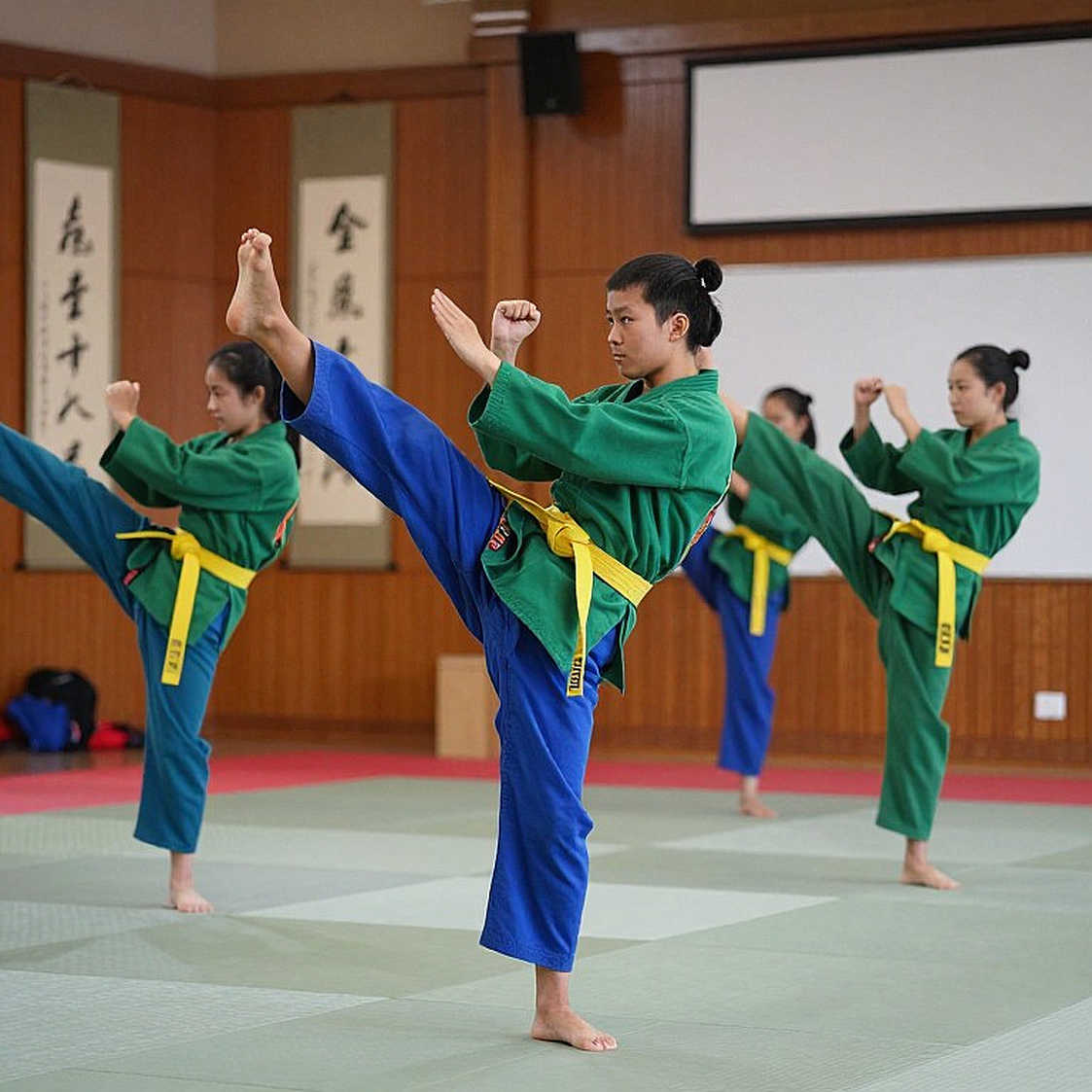
Phung is that axle. You can slot Chau Tuyet Van in beside him, and out comes gold. You can slot Le Kim in beside him, and out comes gold. He is the constant in an equation with two different variables, and the output does not change. This data point stands on its own, and it stands fairly firm, because it is the result of two cycles rather than one lucky afternoon.
I have to gag my own arrogance here, because I notice I am writing in the voice of a man who called it. I did not call anything about this medal. When the Korean arena went quiet and I looked back at the footage, what I realized was that I had never truly understood the cleanliness of forms until I saw a pair finish a routine and could not hear which of them was half a beat late.
Let us talk about Le Kim, because she carries the heaviest load in this whole story. She appears in the gold-winning mixed pair, and she appears in the women's team trio competing the very next day. In elite sport, the athlete entered in the most events always carries two things at once: the highest competitive value and the highest injury exposure. The Vietnamese coaching staff are concentrating equity into a single carrier, and so far that carrier has held. But concentrated equity is fragile equity. This is not a criticism. It is a question mark for the next cycle.
And look at Chau Tuyet Van, once more, in the way the articles do not. She competed in the individual U40 category and also in both the U50 pair and team categories within the same championship. A forms athlete appearing in two age brackets at one world championship is not a sign of decline; it is a sign of deliberate calculation. Either she is right at the U40 ceiling and the coaching staff chose to enter her in an extra event to maximize medal probability, or U50 is where the team's best odds sit and they want her experience to lock it in. Either reading says the same thing: this is a coaching staff that manages entries deliberately, not a team that registers out of habit.
This leads to a structural observation about the discipline that I want you to carry with you when you read any poomsae result over the next ten years.
WT Poomsae operates by age bracket, not by weight class. U30, U40, U50, and internationally the ladder extends past 65. This structure has an upside: it allows a competitive career longer than almost any combat discipline, and it gives veterans like Chau Tuyet Van a stage on which time does not shut the door behind you. But it has a downside, and that downside explains why Vietnamese athletes win medals in the U40 and U50 brackets rather than in a single peak division: age brackets proliferate world titles, and every time you multiply a title, you dilute its scarcity in the eyes of the market.
I say this not to diminish the medal. I say it so you understand why a poomsae gold in an age-bracket category carries high prestige within the sport and low commercial value outside it. And that is the key to the most uncomfortable part of this article.
Let me break a template I once lived inside myself.
In the summer of 2026, I said something on air that made the whole room laugh. I said the coach had to push his fastest player into the centre-forward role instead of the wing, because that speed would punish a high defensive line. Colleagues called me a tactical clown. When what I described happened, they called me for takes. I tell this story not to praise myself. I tell it because it taught me a lesson about the danger of predictive reflex: once you have called it ahead once and been right once, the temptation the next time is to want to call everything ahead.
With Chuncheon poomsae, I will not do that.
What I want to say against most of the online reaction is this: the genuine economic value of this medal is close to zero at the commercial layer, and that is fine. Poomsae is not a ticketed pay-per-view product. There is no PPV, no big sponsorship package, no individual endorsement deal of the kind a professional fighter signs. The budget of this discipline comes from federations, from the state, from host-city investment, from WT-level commercial partnerships and from Olympic-movement solidarity support. In that model, a world-championship gold converts into exactly three things: national prestige, a justification for federation budget allocation, and a pull force for grassroots enrolment.
All three are real, but none of them pays an athlete the way a PPV scoreboard pays. If you are reading this medal expecting a commercial wave for Vietnamese taekwondo, you are applying the template of professional boxing to a state-funded discipline. That expectation will break, and when it breaks, the person blamed will be the athlete, not the model.
Picture it a little differently: a forms pair, middle-aged, nobody punched in the head, nobody cutting weight, wins a world title and receives in return the recognition of a federation and a medal bonus whose figure the press does not print. That is the reality of this discipline. It is less seductive than the story of a fighter entering the cage for money, and that is precisely why we need to discuss it with technical respect rather than in the language of entertainment.
Now to risk and health, the part I must state clearly because I am a reporter of martial arts, not a painter of pretty pictures.
In most combat disciplines — boxing, MMA, kickboxing, sanda — there are two risk categories we always have to address: brain injury from cumulative impact, and the accidents of extreme weight-cutting. Poomsae has neither. There is no head contact, so brain-injury risk here is effectively nil. There is no weigh-in, so the entire apparatus of weight governance — pre-fight scales, water cuts, rehydration clauses — vanishes from the picture. This is one of the healthiest disciplines in the whole martial-arts domain in which you can compete at world level.
The remaining risk, and it is a real one, is musculoskeletal injury from repetitive load. High kicks, thousands of jumps and landings in the training hall, movements that open joint range to its limit — they accumulate in ankles, knees, hips and hamstrings over time. This is a class of injury that does not kill and does not draw attention, but it decides whether a career lasts twenty years or ten.
And here is where I want you to look at the competition load of the Vietnamese squad. Le Kim competed in two events on two consecutive days. Chau Tuyet Van competed across two age brackets at one championship. These numbers are not alarming, but they trace a fairly high load line for a thin roster. In a discipline whose career span can extend past sixty, the real question is not "how many more times can they win" but "how many more cycles can they keep their bodies intact."

There is no information in the reporting I read about injuries, rehabilitation, or training volume. I will not fabricate a projection about anyone's physical condition. I will only say: this is the variable you should track over the next two years, not the medal count.
At this point I want to speak directly to the elephant in the room.
One phrase repeats across the reporting: Vietnam won "the first gold of the championship." Technically accurate, but dangerous because it is easily misread. "First of the championship" means the first gold the Vietnamese delegation won at this Chuncheon 2026 edition. It does not mean the first gold in history, and it does not mean a historic breakthrough. Meanwhile, in this mixed-pair U50 category, Vietnam is in fact defending the title — because the Vietnamese pair itself won gold in Hong Kong 2026. This is the difference between "first-ever coronation" and "title retention." The two are entirely different stories in meaning, and conflating them is an editing error that deserves to be named.
I do not blame my colleagues. I understand the pressure of a newsroom that wants a strong headline. But when you say "first" and the reader cannot tell whether it is "first of this edition" or "first in history," you are selling an emotion the data cannot carry.
Now to the part I call the most dangerous to write, because it demands I contradict myself.
The scenario I just laid out has a weakness, and I want to put it on the table before you find it. My entire argument that "the medal is devalued because Korea was absent" depends on one assumption: that Korea's absence is a meaningful absence in sporting terms. But I have no evidence for that. I have one line in the source report. The most reasonable counter-scenario is this: Korea's absence may not mean they entered no one, but that they did not register in the mixed-pair standard U50 category at all — and that would suggest this age bracket simply is not in their allocation priorities, not that they would win if they entered. If that is the case, the "benchmark" I just erected is only a benchmark on paper, and the weight of my argument drops considerably.
I leave that hypothesis intact, unwrapped. If you have data on Korea's entry list for this event, send it to me. I am ready to correct the piece.
And a second counter-hypothesis, for the asset claim: I praise Nguyen Thien Phung as the constant of the equation, and I do so on the basis of two cycles. But two cycles is a small sample. If the 2026 pair won mostly because of Chau Tuyet Van, and this year's Chuncheon bracket was thinner, then I am assigning to Phung a role that actually belongs to the tournament structure. Without scores, I cannot distinguish between these two explanations. This is the real limit of journalistic data in a judged discipline, and I choose to state it rather than hide it.
That brings me to the close, not with a summary, but with a look forward.
I thought I was born to provoke. It turns out I was born to say what others keep in their throats. And what I am keeping in my throat, after watching that footage nine times, is this: Vietnamese poomsae has proven the hardest thing in any team-driven sport — repeatability. They changed personnel and still won. But that repeatability is standing on a single leg, on a single axle, in a bracket missing its benchmark opponent. Those three conditions together produce a real and respectable achievement, and one more fragile than it appears.
What I want to see in the 2028 cycle is not a third gold. What I want to see is an answer to the question nobody is asking: if Korea enters a pair in this category next time, what will the score be, and who will be half a beat late?
Modern football is so perfect that I crave spectacular mistakes. Poomsae is the opposite: it is so perfect that you have to count hundredths to find the flaw. And precisely for that reason, when you swap half of a world-champion pair and still come out with gold, you are not permitted to praise only the beauty. You have to go and find the axle.
That axle, as of the Chuncheon afternoon, has a name: Nguyen Thien Phung. And until there is evidence to the contrary, I am betting on that name, not on the medal.